




The global security order is being redrawn at pace. The war in Ukraine, rising tensions in Asia, and the growing strategic importance of the Arctic have positioned defence and security as central drivers of both industrial policy and capital allocation.
Last weekend’s Munich Security Conference—an annual barometer of the transatlantic relationship—pointed to a deeper systemic realignment. The Munich Security Report 2026, “Under Destruction,” concludes that the rules-based international order is eroding, a view reinforced from the podium.
One year after JD Vance’s sharp criticism of Europe over defence, migration and free speech, Marco Rubio was met with relief for his softer tone. Yet behind the diplomatic framing lay the same strategic core: the United States is redefining “the West” in nationalist and civilisational terms, signaling that cooperation will increasingly take place on American terms.
Rubio’s avoidance of mentioning of Russia, Ukraine and Greenland was notable. Meanwhile, discreet U.S. initiatives concerning the Arctic underscore that power-political ambitions remain intact despite softer rhetoric.
Munich 2026 made clear that the transatlantic divide is less about tone and more about structural divergence in strategic interests and worldview. Europe is actively seeking a path forward, but credibility will ultimately be determined by operational delivery—unity, execution, and the ability to translate ambition into capability.
In parallel, the war in Ukraine continues. Military tensions in the Middle East persist. Uncertainty surrounding Taiwan remains elevated. The Arctic and Greenland are gaining strategic prominence. Together, these developments illustrate how geopolitics and security have become decisive factors for global trade and financial markets. The boundary between geopolitics and geoeconomics is increasingly indistinct.
A New Geopolitical Reality
Relations between the United States and its allies in both Europe and the Asia-Pacific (APAC) region are undergoing recalibration. Rising tensions around Taiwan, the South China Sea and regional military build-ups are reshaping defence and industrial cooperation. Questions of burden-sharing, strategic autonomy and industrial capacity have moved to the forefront, underscoring the need for a broader recalibration of both security and economic policy.
NATO members are raising defence spending ambitions, while the U.S. and its APAC allies are expanding military commitments, creating long-term global investment opportunities. Partnerships such as AUKUS, Five Eyes and the Quad are gaining prominence alongside NATO.
Europe’s Strategic Autonomy Takes Shape
In parallel, Europe is pursuing a more assertive and goal-oriented defence policy, focused on building domestic capacity across priority military and security domains. This shift is not merely rhetorical—it is backed by substantial financial commitments.
The EU has approved €90 billion in support for Ukraine for 2026–2027. Combined with rising national defence budgets, this signals a durable and long-term anchoring of Europe’s security engagement.
The operational framework is supported by the EU’s Readiness 2030 strategy and its flagship initiatives, which prioritise coordinated capability development:
- European Drone Defence Initiative – An integrated system for detection and neutralisation of hostile unmanned systems.
- Eastern Flank Watch – Enhanced surveillance and defence along the EU’s eastern border through combined sensor and response capabilities.
- European Air Shield – A joint air and missile defence system to protect critical infrastructure and assets.
- European Space Shield – Protection of European space-based assets and enhanced space situational awareness.
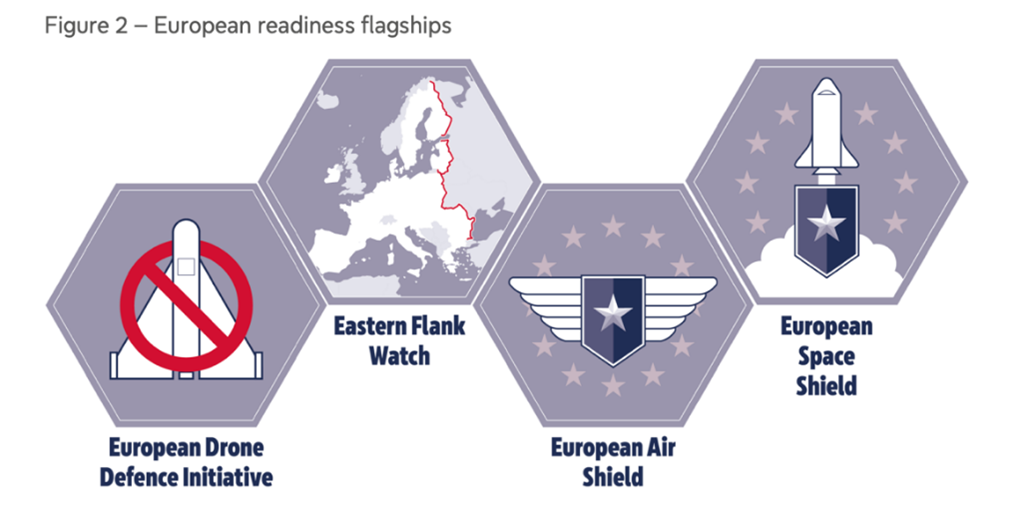
Collectively, these initiatives span both technological capabilities and strategic infrastructure, providing clear direction for Europe’s defence policy through 2030.
A likely consequence is that European companies will capture a larger share of European defence procurement.
The United States: From Efficiency to Resilience
In the United States, the emphasis is increasingly on delivery capability and industrial resilience rather than technological edge alone. The defence industry has shifted from just-in-time to just-in-case, prioritising scale, long-duration contracts and supply chain security.
This shift has been reflected politically. President Trump has urged defence contractors to prioritise capacity expansion and delivery reliability over share buybacks, dividends and elevated executive compensation—framing industrial preparedness as a national priority.
Strong Sector Performance – Execution Now Critical
These structural drivers explain the defence sector’s strong performance throughout 2025 and into early 2026. Increased budget commitments, clearer policy signaling and expanding order books have provided strong visibility. The latest reporting season (Q4 and full-year 2025) confirmed this trend, with multiple companies posting record backlogs, robust organic growth and margin expansion.
The next phase, however, requires significant production scaling. Operational execution will increasingly differentiate companies and determine whether current premium valuations are justified. For investors, this underscores the importance of selectivity and a clear understanding of which companies can efficiently convert backlog into revenue and free cash flow.
Several companies have indicated that improved production efficiency, higher capacity utilisation and strengthened supply chains could support continued margin expansion—even as growth rates gradually normalise.
A Broader Value Chain – New Winners Emerging
At the same time, the value chain is broadening. Smaller, specialised players are increasingly positioned as strategic suppliers within niche technologies critical to Europe’s capacity build-out. Through focused specialisation, technological depth and long-term customer relationships, these companies may strengthen competitive positioning and gradually improve profitability.
Key Questions for 2026
- At what pace and to what extent will U.S. military presence in Europe evolve?
- Which companies are best positioned to capture rising defence and security investment in APAC?
- Will U.S. technological dominance persist in next-gen systems like AI and autonomous solutions?
- How will Ukrainian combat experience influence future European procurement?
- Which capabilities will benefit from increased NATO presence in the Arctic?
A New Investment Paradigm
The trajectory of the defence sector points to a new investment paradigm: defence and security are increasingly regarded as structural, long-term allocations rather than tactical exposures. In a more fragmented and uncertain global landscape, the sector is expected to exhibit lower correlation to traditional business cycles—strengthening its role as a portfolio diversifier.
Analysts often argue that geopolitical shocks rarely impact corporate earnings. However, when geoeconomics is reshaped through new trade flows, capital reallocation and shifting security priorities, the corporate playing field changes as well. To assume otherwise is to underestimate how deeply intertwined geopolitics and economic outcomes have become.