




Sakai Chemical
We purchased Sakai Chemical in October for both funds and are now a 7% shareholder. The business that is doing extremely well is the dielectric materials and products. The main customers are MLCC manufacturers (multi-layer ceramic capacitors). Sales in the third quarter of FY24 rose by 21%, and operating margins edged up to 15%. The end demand drivers are smartphones and server-related demand (AI). The longer-term compound annual growth rate (CAGR) is 8%. They supply both barium titanate and barium carbonate, holding a global share of 40% in barium carbonate. The competition includes Nippon Chemicon and Solvay (Belgium). Similar sales in the fourth quarter are likely, and next year the drivers are server demand and smartphone cycle normalisation. They have managed price hikes. Longer-term, they are a great play on the EV market and demand for storage.
In cosmetics, sales have been lacklustre, but we knew this. In fact, profits were only ¥11m in the third quarter. Supplying sunscreen chemicals is their key strength, with domestic demand at 60% and overseas at 40%. Indirectly, they have a lot of exposure to China as the Japanese cosmetics companies have heavily geared towards this geographic area. Next year, they will see a huge boost to sales from three new brands using their product. These are European clients. This could be a 10-20% addition to sales. I am confident that the company will deliver here. Long-term CAGR is 5%.
In organic materials, they have two segments:
1. Plastic lens monomer for eyeglasses that enables thinner lenses
2. Pharmaceutical intermediaries.
There has been some inventory adjustment in eyewear, and sales have not been particularly strong, but the pharmaceutical side has been strong. Long-term CAGR is 5%.
The contract processing is a remarkably stable 10% operating profit margin (OPM), and in titanium dioxide, they will exit this division next year. This is 16% of sales and was loss-making last year. The company recently revised operating profit to ¥5.7bn from ¥5.4bn for 3/25 and to ¥8.6bn for 3/27. This includes:
- ¥5.7bn in growth areas such as electronic materials, cosmetics, and organic chemicals.
- ¥2.7bn in the cash cow businesses such as hygiene products.
The exit from titanium dioxide will be earnings enhancing straight away.
The below shows how far Japanese companies are going to change. I cannot remember seeing a cash conversion cycle improvement cited in a small-cap capital allocation document.
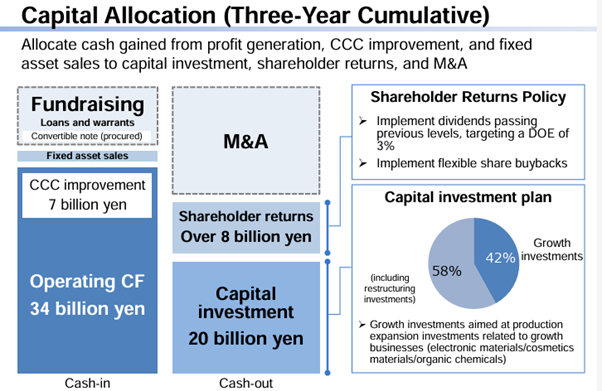
If we are correct, then the total payout per annum will be 6-7% per annum with a 4.8% dividend yield and buybacks of circa 2% per annum.
We think the initial operating profit estimate will be ¥6.7bn with EPS over ¥350, putting the shares on a price-to-earnings ratio (PER) of 8x and a price-to-book ratio (PBR) of 0.58x.