




(For background on this topic please refer to Loupe entries from April 2025 as well as the Havas entry from November 2025 and the Software entry from December 2025)
It has been an interesting start to the year. Although the NAV at 27/2/26 is moderately ahead of the year-end level, this masks a fair bit of underlying movement:
- One quarter of the portfolio is up by around a third on average
- One quarter of the portfolio is down by around a quarter on average
In the first category is a basket of companies that mostly ‘make things’: Vallourec, the French manufacturer of steel pipes; Cicor, the Swiss electronic manufacturing services company and our two Dutch-listed semi-conductor capital equipment companies all being examples.
In the second category, a meaningful part of our portfolio – particularly software and IT services - has sold off sharply. The market’s concern is clear, namely that AI will disrupt the future economics of these businesses. Our exposure to these two sectors is as follows:
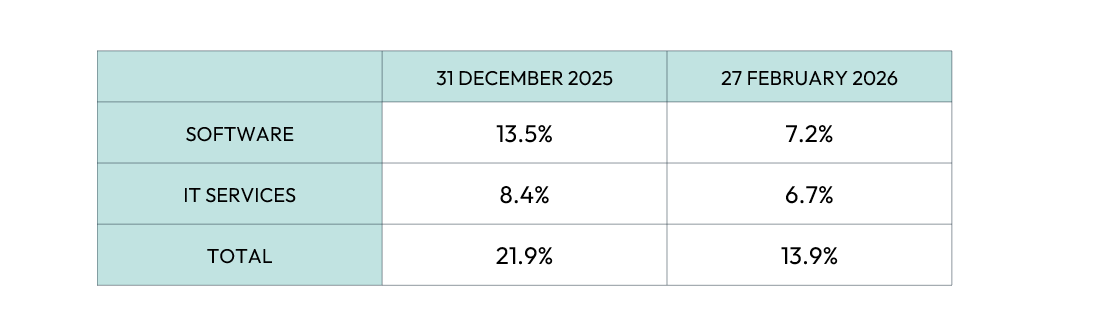
Source: Chelverton Asset Management as at 27/2/26
In response, we have reduced aggregate exposure, shortened portfolio duration and reallocated capital towards less disruption sensitive cash-flows.
Respect for Historical Lessons
We have a deep respect for the lessons of past technological change. Some business models that have thrived over recent decades may prove less resilient in an AI‑driven future, and it would be complacent to dismiss that risk.
Given the embedded nature of products and services our companies provide, we don’t think disruption or change will occur overnight. We do acknowledge however, that AI is more a risk to certain types of business model than others and that we don’t know how AI will impact these models on a 3/5/10 year time horizon – exactly the type of time horizon we invest over.
Back to Basics
At the core of investing is a simple principle: the value of an equity is the sum of its future discounted cash flows. AI and potential business model changes increase uncertainty around those future cash flows. This is more acute for so-called ‘long‑duration’ growth companies where a large proportion of value lies further into the future. By contrast, shorter‑duration businesses require fewer years of ‘business as usual’ assumptions to justify their valuations.
Our process tools, especially the DCF model, are designed to deal with exactly this type of uncertainty and the widening range of outcomes that we are now seeing possible.
This core principle and the distinction between long and short duration cash flows have become highly relevant in our current thinking.
Reduced Exposure, New Holdings
Following a review, we concluded that our aggregate exposure to technological disruption had become too high. While we continue to support individual holdings, based on their resilience and opportunities to benefit from AI, we have reduced overall exposure. Our scenario analysis suggests that if (and stress, if) business models do change negatively, a small handful of our companies could still have significant downside from here – even after falls. These are the companies we have addressed by this reduction.
As we have commented many times, decisions such as this are always easier when you have a strong bench and long-term opportunity cost is low. We have reallocated capital towards areas less vulnerable to AI‑driven disruption, initiating two new positions and topping up other existing holdings. We will provide more detail when trading allows, but the new holdings include:
- A Nordic provider of plumbing and electrical support services to buildings and factories
- A German manufacturer with a high service profitability and contribution to cash flows
Valuations Still Matter
All businesses have a threat of some form of disruption. The critical question is what the probability of disruption is, and how this is considered in valuation.
Havas is a good example. We purchased Havas specifically because the market assumes it will be disrupted. However, on a PE of 7x and a FCFY of 15%, the implication is, all else equal, Havas has no profitable existence beyond the next 7 years. This is an equation we are prepared to back. Valuations still matter and we are comfortable underwriting unpopular equations when valuation compensates.
We have an ‘AI Watchlist’ which includes Havas, our software and IT service companies and 3 other holdings where our views differ from the market on disruption risks, especially when considering valuation aspects. As at 27/2/26 this watchlist was 21.4% of the portfolio and it is currently valued as follows:
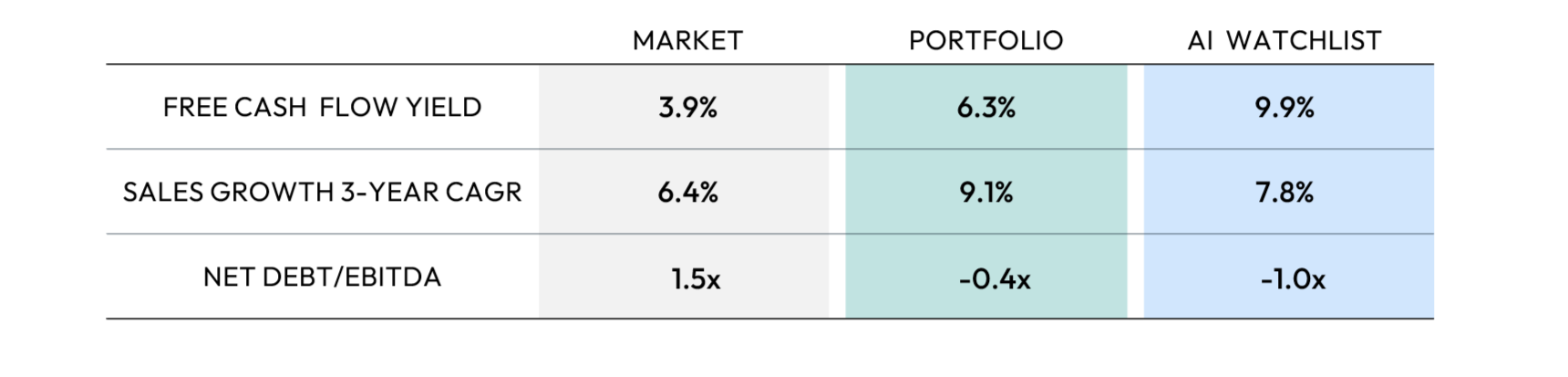
Source: Chelverton Asset Management as at 27/2/26
This segment is now presenting as cheap with extremely robust Balance Sheets. Even if growth does not materialise to the level expected, there is healthy compensation from short duration FCF – a relevant distinction if disruption takes time to materialise.
Price v Value
In reallocating capital as we have done, we effectively shorten the duration of our expected cash-flows and lower our exposure to future uncertainty, from not just AI, but in general.
We are in the middle of reporting season. This allows us to focus on concrete datapoints, go into process, refine valuations and better understand whether concerns are behavioural or genuinely structural, and how this impacts our ongoing portfolio risk management.
Process is in place to help us in moments of volatility like this. Discipline around valuation, duration and balance sheet strength matters, and these are amongst the factors we will be leaning on the most.
Thanks for your interest. We will keep you informed and if you have any specific questions, please let us know.