




After the war-related sell-off in March, global stock markets have recovered some ground, with company earnings remaining robust and hopes of a ceasefire deal between the US and Iran beginning to rise.
A growing disconnect between fundamentals and share prices
As discussed in recent views, UK-listed quality shares have been very out of favour over the past two years, with UK market returns concentrated in asset-intensive cyclicals - most notably banks, miners and oil companies. Many financial and resources companies have trebled, quadrupled or more since 2020. They were a big part of the UK market then, and they have subsequently become an even bigger part – Financials, Basic Materials and Energy now make up nearly 50% of the FTSE All-Share. Meanwhile, the US market (and the global market by proxy) has become concentrated in and dominated by the AI capital investment trade. Trends are very polarised, with the momentum factor having its strongest run in global markets since the 1999/2000 period.
Evenlode Income’s underlying holdings continue to generate a very healthy amount of cash and – as discussed in the section below – are growing at a good rate in aggregate. Valuations have been grinding lower though. This combination of solid fundamentals and valuation de-rating has left the portfolio at its most compelling valuation since the fund’s launch in the 2009-11 period. The following chart shows the fund’s recent valuation de-rating in terms of the rise in free cash flow yield[i]- a key valuation measure for us. Despite the competitive advantages, growth potential and capital-light, cash generative economics these companies enjoy, the free cash flow yield of the fund is currently higher than the FTSE All-Share Index and nearly twice as high as the MSCI World Index.
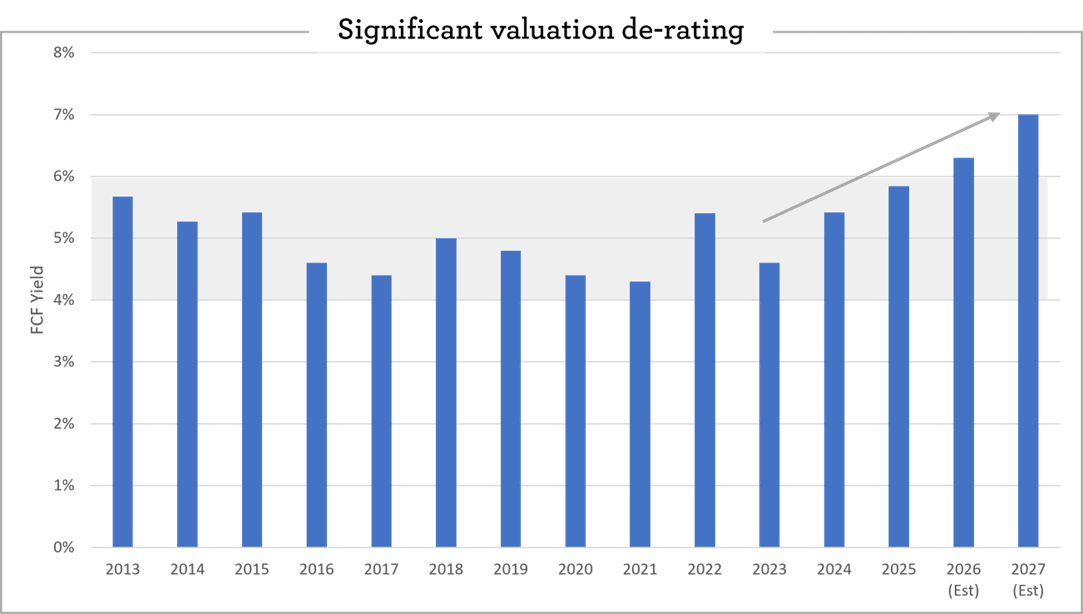
Source: Evenlode
First quarter results
The global economy has faced a challenging first five months of the year. The US economy is being helped by the staggering large investments being made in AI datacentres, but much of the rest of the global economy has faced headwinds with the Iran war triggering a spike in oil prices. Global consumer confidence - not least in the US - remains depressed.
With this backcloth, it is reassuring that the forecast for aggregate portfolio growth in 2026 remains similar to the start of the year. The expectation is for more than +5% organic revenue growth[ii], more than +8% organic operating profit growth[iii], and double-digit earnings per share[iv]growth.
Of the 35 holdings in the fund, 33 are forecast to deliver profit growth for 2026. The other two holdings, Diageo and Bunzl, are expected to deliver stable profit year-on-year.
Results round-up
With the first quarter results season now finished, below is some colour on how a range of business models held in the portfolio are faring, including a selection of this year’s faster, medium and slower growing holdings[v].
Compass (Dividend Yield[vi]2.3%; Free Cash Flow Yield 3.8%)
As the global market leader in food catering, Compass remains well placed to benefit from the structural outsourcing trend in its key end markets – Sports & Leisure, Business & Industry, Healthcare & Senior Living, Education, Healthcare and Defence, Offshore & Remote. Clients want to focus on the day job in a world of food inflation, supply chain complexity, tariffs, changing consumer dietary preferences and increased health and safety requirements. Compass has the expertise and procurement scale to manage these complexities and deliver high-quality, good-value food in a wide variety of settings.
At the latest interim results, the company reported organic revenue growth of +9% and operating profit growth of +12%, with client retention rates remaining very high at 96%. As with many management teams we speak to, the use of technology and data at scale is helping Compass grow in an efficient manner.
Spirax Group (Dividend Yield 2.6%; Free Cash Flow Yield 3.8%)
Spirax is a global thermal energy management and fluid technology solutions group. Though its industrial clients have faced higher energy costs from the Iran war, Spirax has seen a solid start to the year and maintained guidance of mid-single-digit organic growth alongside margin expansion. Spirax is very well placed to help its customers electrify their industrial processes and increase efficiency – a helpful long-term demand underpin. Much of the company’s revenue is predictably steady, generated either from maintenance expenditure, or relatively low-cost items funded from in-year operating budgets that generate an attractive, short-payback return-on-investment.
More generally, across the fund’s speciality engineering exposure, we continue to see an attractive combination of strong competitive positions, structural growth potential and valuation appeal.
Intercontinental Hotels Group (Dividend Yield 1.3%; Free Cash Flow Yield 3.6%)
IHG has also faced headwinds from the Iran war, via disruption to travel in the Middle East. Despite this, the company beat expectations for the first quarter, with +4.4% organic revenue growth, and reiterated full-year guidance:
The impact of the Middle East conflict and some wider disruption to international travel flows is expected to be more than offset by increases in demand elsewhere. Our business model is strategically diversified and resilient in capturing demand across geographies, chain scales and the different stay occasions of business, leisure and groups travel, as well as being heavily weighted to domestic and intra-regional travel.
IHG’s growth algorithm remains the delivery of +12-15% annual earnings growth over the medium-term, with very high cash conversion thanks to its franchise model.
Integrafin (Dividend Yield 3.9%; Free Cash Flow Yield 5.8%)
Integrafin has built a strong niche leadership position, via the provision of its Transact investment platform to the UK financial adviser community. Its bespoke platform, reinvestment in product development and close relationship with clients all lead to very high retention rates. Integrafin’s share of the UK adviser platform market is over 10% and steadily growing, with the company’s share of net inflows into the sector running at well over 20% thanks to its strong offering (which includes no margin being taken on interest on any client cash held on the platform, unlike many of its peers whose profitability has become dependent on this factor).
At recent interim results revenue rose +11% and earnings +14%. Management are beginning to see significant operating efficiency flow through from the investments they have made in automation and AI enhancements.
Smith & Nephew (Dividend Yield 2.6%; Free Cash Flow Yield 6.1%)
Smith & Nephew management has put some serious work over the last few years into improving the company’s operational resilience and efficiency, and its innovation function. These efforts are beginning to bear fruit, and after good growth last year the company reiterated guidance for the year of +6% organic revenue growth and profit growth at a higher rate. We think the forward Price-to-Earnings (PE) ratio[vii]of 12x in no way reflects the quality of Smith & Nephew’s positions in Advanced Wound Management, Sports Medicine and Orthopaedics. If the market fails to recognise intrinsic value, strategic portfolio options are possible to help unlock it.
RELX (Dividend Yield 3%; Free Cash Flow Yield 5.5%)
The digital business models held represent just over 20% of the portfolio and have been the most negative contributors to return since the start of the year. They're all slightly different, but we continue to see the competitive positions of the companies held as robust in the world of generative AI. Important factors include a combination of constantly updated proprietary data and content (that just can’t be replicated from public sources) and an overlay of continuously improving algorithms on top of these datasets. This is augmented with the specialist domain expertise they have (often in highly regulated markets where trust is key and the cost of failure is high) and deep embeddedness within customer's workflows. The consistent reinvestment they're making in product development and functionality - including generative AI – is also important. We're monitoring very closely competitor and start up activity, and we're reassured with how these holdings continue to be positioned in their markets. A discussion of RELX’s Risk division is included as an appendix to this piece, as a case study of some of the points made above.
At RELX’s latest trading update, management re-iterated full-year guidance and reported a strong start to the year, noting positive momentum across the group. Management continues to see the company as a net beneficiary of generative AI.
Experian (Dividend Yield 2.3%; Free Cash Flow Yield 6.0%)
Experian is another digital business model that views generative AI as an incremental benefit for the business. Though macro-economic conditions have been tough in its credit-related end markets, for its full-year to March 2026 Experian grew organic revenue +8% and earnings per share +13%. Earnings per share growth is also expected to be comfortably double-digit for the current year. Experian has stepped up its share repurchase programme to take advantage of the currently depressed valuation – announcing another $1bn buy-back on top of the $1bn announced in January. This means the company is in the process of buying back nearly 6.5% of the shares in issue this year.
The below quote from management is instructive from the perspective of generative AI:
Artificial Intelligence (AI) is becoming a core driver of how we operate and grow. We are embedding it across products, platforms and workflows to improve performance. It is already driving measurable efficiency gains, with a c.10-15% uplift in coding productivity in our financial year to March 2026 and select areas achieving gains of over 30%. To put this into context, labour costs, at 32% of revenue, are over 3% lower than two years ago. It is also helping us to extend our reach in existing and new markets. We have already identified over $15bn of AI-enabled addressable market opportunities, in Health, agentic commerce, Ascend platform expansion and embedded consumer marketplaces, and we are positioning the business to penetrate these emerging areas. We see accelerating internal and external opportunities as usage scales across the organisation, which will support continued margin delivery in line with our Medium-Term Framework expectations, alongside additional revenue expansion.
Unilever (Dividend Yield 4%; Free Cash Flow Yield 6.1%)
We discussed Unilever in more detail in last month’s investment view. Since then, the company released a first quarter trading statement, posting volume-led +3.8% organic revenue growth, and reiterating guidance for the year of +4-5% organic revenue growth with modest operating margin expansion.
Management noted the degree to which they have become accustomed to managing the ‘new normal’ of supply chain complexity and spikes in input cost inflation. Their reiteration of 2026 guidance includes an assumption of oil prices hovering around $115 per barrel for the rest of the year.
There is an interesting, more general point here. The last five years have included the convulsions of Covid, the Ukraine war, US tariffs and now the Iranian war. In coping with these multiple shocks, companies have become leaner machines as a result and better equipped at coping with supply shocks. Technology and data at scale have been helpful contributory tools in these efforts.
Unilever is a well-invested, growing business that has done a good job over the last decade at pivoting towards the Beauty, Personal Care, Wellbeing and Home Care categories. A forward PE multiple of approximately 14.5x (or 12.5x if one strips out the Hindustan Unilever stake) is very modest for the quality of its brand portfolio, global scale and embedded distribution network.
Howden Joinery (Dividend Yield 2.9%; Free Cash Flow Yield 5.9%)
We also discussed Howden in last month’s investment view. The company has since released a trading update. Howden reported sales growth of +3.7% over the latest period and management reiterated guidance for the current year. Howden’s in-stock model – including vertically integrated manufacturing and a near-sourcing approach – is particularly strong versus competition in times of input cost inflation and supply chain challenge.
We continue to see the company as a coiled spring. Kitchen volumes are running more than 20% below the long-term average, lower than the 2009 trough. Howden remains well invested and in a unique position to capture volume upside when it finally materialises. Though not a central expectation for us, there is a credible route to a doubling of earnings if market volumes did mean revert over the medium-term.
Diageo (Dividend Yield 2.5%; Free Cash Flow Yield 6.2%)
At the recent third quarter trading statement, Diageo management reiterated guidance for flat to low-single-digit profit growth in the current financial year. Strong growth from Guinness, Latin America and Africa was offset by continued weakness in US Spirits. We view the downturn in the US spirits category as a combination of affordability and health-related trends, but with affordability being the more significant factor. New management are investing behind Guinness to drive continued growth, whilst also taking steps to meet the pressured US consumer where they are with mid-tier price points and ready-to-drink products both areas of focus. Recent discussions with management suggest that the potential for improving profitability over time is also significant. Diageo’s forward PE multiple is 13x – very depressed, in our view, for an excellent portfolio of global brands.
Bunzl (3.3% Dividend Yield; Free Cash Flow Yield 8.6%)
Bunzl and Diageo are expected to deliver the least progress in operating profit this year, with a flattish result forecast for both. Bunzl had a tough year last year with a strategic misstep in its North American division. The company’s recent trading statement was reassuring, reconfirming guidance for the year and the continued improvement in last year’s problem division. Bunzl also noted that the acquisition pipeline remains healthy. These bolt-on acquisitions are a key part of the long-term growth model, given the highly attractive returns-on-capital that the company can generate from them.
Bunzl is another holding – on a forward PE of 12.5x – that is being given little or no credit for the quality of its compounding model (+9% earnings growth per annum over 20 years), its high returns on capital, and its prodigious cash generation.
The fundamental algorithm
Markets have become increasingly driven by narrative and momentum over recent months, but the long-term laws of investment haven’t been repealed. The total return algorithm for the fund suggests a strong fundamental return from here. A 3% dividend yield and a 2% buyback yield mean that earnings growth of 5% or more is all that’s needed to drive a total return of more than 10%, assuming no change in valuation.
If anything, recent announcements suggest the buy-back yield is heading up above 2% on a forward-looking basis, with 80% of holdings now actively buying shares.
The problem for total returns over the last two years has been that the portfolio has been getting steadily cheaper. This de-rating trend only needs to stop to allow the total return algorithm to shine through. Given how depressed current valuations are relative to history and to global peers, we also see the potential for a significant valuation re-rating of the portfolio over time, this would be the icing on the cake.
Hugh, Chris M., Ben P, Charlotte, Leon and the Evenlode team
29 May 2026